DOMINION TERMINAL ASSOCIATES
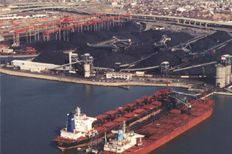 Dominion Terminal Associates (D.T.A.) is located on the east bank of the James River in Newport News. The terminal is owned by Alpha Metallurgical Resources, Inc. and Arch Resources, Inc.
D.T.A. has an annual throughout capacity of 22 million tons and can accommodate vessels ranging from barges to ships of 178,000 dwt. Coal is received from the coal fields of Virginia, West Virginia, and Kentucky through CSX Transportation.
The tandem rotary dumper can unload coal at a rate of 5,700 tons per hour. A system of nineteen 72-inch and 84-inch belt conveyors transports the coal from the dumper to storage or direct to the shiploader. Coal is stored in four areas, capable of storing up to 1.7 million tons, and later reclaimed for shipment by two stacker/reclaimers and one reclaimer. These three machines have 200-foot booms and are capable of luffing, slewing and traveling along the length of the storage areas to stack and reclaim the coal with a minimal amount of dozing.
Coal can be reclaimed and transported to the twin silos at 6,800 tons per hour where it can be blended and loaded onto vessels at up to 6,500 tons per hour. The single shiploader with a 145-foot boom can accommodate ships with 79-foot air draft. Pierside, D.T.A. matches the harbor’s 50-foot depth.
KINDER MORGAN BULK TERMINALS - PIER IX
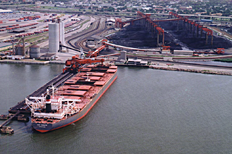 Pier IX Terminal was completed and became operational in December 1982. Loading facilities include double berth pier with a belt conveyor system, single shiploader, and an air draft of 65-feet, capable of loading 85,000 to 90,000 ton colliers in a day. Berth and loading facilities will accommodate vessel length of 1,000-feet and breadth of 155-feet. The storage facility has a rated annual capacity of 12 million tons of coal per year with ground storage of
1.36 million in 12 piles.
Pier IX Terminal was completed and became operational in December 1982. Loading facilities include double berth pier with a belt conveyor system, single shiploader, and an air draft of 65-feet, capable of loading 85,000 to 90,000 ton colliers in a day. Berth and loading facilities will accommodate vessel length of 1,000-feet and breadth of 155-feet. The storage facility has a rated annual capacity of 12 million tons of coal per year with ground storage of
1.36 million in 12 piles.
The Terminal is served by the CSX Rail System which accesses the highest qualities of metallurgical and steam coals with competitive rail rates. Kinder Morgan Bulk Terminals (KMBT)-Pier IX offers mechanical sampling to and from storage, and multiple stockpile loadings instantaneously.
In June 1991, KMBT-Pier IX began operation of a cement unloading, storage and truck
loadout facility. KMBT-Pier X also offers selected drybulk unloading services to stockpile or
transloading from vessel to barge (barge to vessel).
NORFOLK SOUTHERN CORPORATION
Norfolk Southern Railway Company
 Norfolk Southern’s coal pier at Lambert’s Point is the largest coal loading facility in the Northern hemisphere, concentrating at one point the collection and blending of coals originating from approximately 130 mines and preparation plants on its rail system. In addition to the shiploading piers, Norfolk Southern has constructed modern weighing, thawing, sampling and dumping facilities to supply coal to the pier.
Classification and storage yards accommodate approximately 5,200 loaded coal cars at Lambert’s Point, or more than 520,000 tons of coal on hand each day, with additional tracks provided for receiving loaded trains and assembly of empty cars returning to the coal fields. Service is expedited by a high-speed, virtually one-way route for coal trains from the mines
to Norfolk. In addition to Coal Pier 6, Norfolk Southern operates a modern shop for the repair of coal cars before returning to the mines. Pier and yard offices, weighing stations, thawing sheds, yard lighting, roadways and other facilities serve all classes of colliers
quickly and efficiently.
Pier 6
 Pier 6 opened for business in 1963 and in 1999 dumped its billionth ton of coal, becoming the only facility in the world to have reached that milestone. The concrete and steel pier has twin traveling loaders, each as high as a 17 story building and can serve two colliers or concentrate on a single ship. More than 165,000 tons of coal have been loaded into a single collier, some of which are 1,000-feet in length and 175-feet in width. Norfolk Southern Pier 6 details: MV CHINA PROSPERITY is most recent record export from 2019. Vessel loaded a total 156,778.894 mt of coal which is about
172,819 short tons. Lay berth space is
available on the upstream side of the pier
for an additional vessel to await a loading
berth. The pier has a design capacity
of 16,000 tons an hour, with a maximum
capacity of 20,000 tons an hour. During the
fall of 1994, air draft was increased from
55.5-feet to 74-feet. Because cars are
dumped directly to the vessel, premium
blending and mixing of coals can be
accomplished to service the needs of coking and steam coal buyers worldwide.
Pier 6 opened for business in 1963 and in 1999 dumped its billionth ton of coal, becoming the only facility in the world to have reached that milestone. The concrete and steel pier has twin traveling loaders, each as high as a 17 story building and can serve two colliers or concentrate on a single ship. More than 165,000 tons of coal have been loaded into a single collier, some of which are 1,000-feet in length and 175-feet in width. Norfolk Southern Pier 6 details: MV CHINA PROSPERITY is most recent record export from 2019. Vessel loaded a total 156,778.894 mt of coal which is about
172,819 short tons. Lay berth space is
available on the upstream side of the pier
for an additional vessel to await a loading
berth. The pier has a design capacity
of 16,000 tons an hour, with a maximum
capacity of 20,000 tons an hour. During the
fall of 1994, air draft was increased from
55.5-feet to 74-feet. Because cars are
dumped directly to the vessel, premium
blending and mixing of coals can be
accomplished to service the needs of coking and steam coal buyers worldwide.
The coal is carried by a series of 8-foot wide rubber conveyor belts to the loaders where
even-flow retractable booms deposit it smoothly into colliers. The booms can reach out as far
as 120-feet, providing an even-keel loading for ships with centerline bulkheads.
The conveyor belts at Pier 6 are equipped with a sophisticated mechanical coal-sampling
system manufactured by Precision Samplers, Inc. and under lease by Sampling Associates
International, a consortium of four testing laboratories in Hampton Roads. The system samples
coal from the moving conveyor belt and sends it to the top of a processing tower. There, it is
crushed and split several times before final samples are sealed in airtight containers for
laboratory testing.